
World News
Drought crisis deepens in Somalia

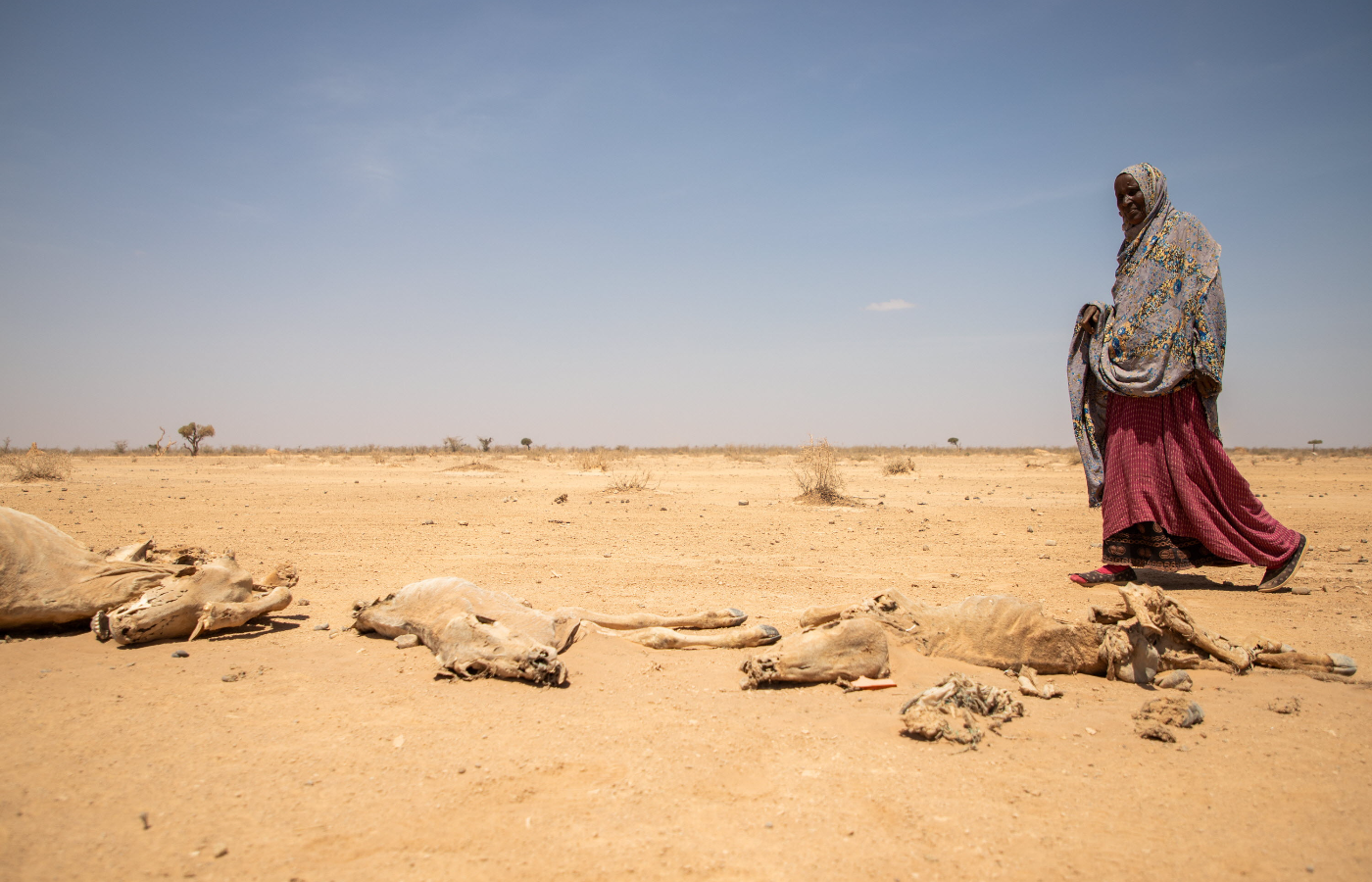
Somalia is grappling with a deepening food crisis as persistent drought continues to grip the East African nation. The lives of more than six million Somalis are hanging in the balance as hunger intensifies across the country.
Reports indicate that on the outskirts of Somalia’s southern port city, vast stretches of land have turned into open graveyards for livestock. Dead cattle lie scattered where they collapsed, while others are buried in shallow graves following several consecutive failed rainy seasons.
The situation is particularly dire for communities living in remote areas who depend heavily on livestock for milk, meat and income. With many animals dead, countless families have lost their primary means of livelihood.
The drought has forced millions of people to skip meals and endure daily hunger. According to a report by Al Jazeera, a combination of prolonged drought and rising living costs is pushing the country deeper into crisis.
The humanitarian director at Save the Children, Francesca Sangiorgi, said the crisis is being driven by repeated climate shocks that have compounded over time.
“We’re seeing multiple rainy seasons that have failed across the country,” she told Al Jazeera, noting that even when rain falls, it is often uneven and arrives too late to restore livelihoods that have already collapsed.
The scale of Somalia’s hunger crisis is severe and worsening rapidly. Nearly a third of the population is facing severe food insecurity, classified as IPC Phase 3 and above. Many households are struggling to obtain enough food to meet their basic daily needs, and in some cases are going without food altogether, leaving them vulnerable to malnutrition and diseases such as diarrhoea, measles and other infections.
Of those affected, more than two million people are already in the most critical conditions short of famine, known as IPC Phase 4 or emergency levels. Families in this category face extreme food shortages and are increasingly forced to flee their homes in search of assistance, often moving to overcrowded aid camps where resources are rapidly dwindling.
Children remain among the hardest hit. According to the United Nations, an estimated 1.8 million children under the age of five in Somalia are at risk of acute malnutrition, putting their survival in immediate danger.
Sangiorgi warned that the situation is deteriorating quickly and its effects are already widespread.
“The situation of children across the country is extremely concerning,” she said. “We’re seeing the spread of child illnesses across the country. Dropout rates are extremely high right now and continue to rise because of the drought. We want to make sure that children have a chance at life — access to the health and nutrition services they need, as well as education.”
Meanwhile, Doctors Without Borders (MSF) reports that more than 3.3 million people have been displaced, placing immense pressure on already limited resources and basic services in affected communities.

Burkina Faso’s military government has announced the severance of diplomatic relations with France, marking a significant escalation in tensions between the West African nation and its former colonial ruler.
The decision, which takes immediate effect, was announced on Friday through state television.
In a statement issued by Communications Minister Gilbert Ouedraogo, the junta said the conditions necessary for maintaining constructive relations between the two countries no longer exist.
“The essential conditions for promoting relations based on mutual respect, reciprocal trust, respect for the principle of non-interference in internal affairs, and national sovereignty are not in place,” Ouedraogo stated.
He added that the government had formally decided to end diplomatic relations with France, effective June 26, 2026.
The military administration, led by Captain Ibrahim Traoré, accused Paris of acting against Burkina Faso’s interests and interfering in its internal affairs. The junta further alleged that France was supporting “subversive networks” and “terrorists,” claims for which it provided no immediate evidence.
Captain Traoré came to power following a military coup in September 2022, amid growing insecurity and public frustration over the government’s handling of jihadist violence.
Relations between Burkina Faso and France have steadily deteriorated since the military takeover, with the junta pursuing closer ties with alternative international partners while distancing itself from its former colonial power.
The latest move underscores the widening rift between France and several military-led governments in the Sahel region, where anti-French sentiment has grown in recent years.

A proposal by Denmark’s Immigration Minister, Morten Bødskov, to ban the Islamic call to prayer (Adhan) has sparked debate over religious freedom and the place of Islam in Danish society.
Bødskov announced plans to explore a legal framework that could prohibit the public broadcasting of the Muslim call to prayer, arguing that the practice does not belong in Denmark and reflects what he described as a growing “Islamization” of public spaces.
“The call to prayer should not be heard over Danish rooftops,” the minister told journalists. “It has no place in Denmark, and you shouldn’t be in any doubt whether you’ve ended up in a suburb of Islamabad when you walk around Denmark.”
He further claimed that what he described as the gradual Islamization of the country was occupying too much public space.
The proposed move could affect Denmark’s estimated 270,000 Muslims, many of whom view the Adhan as an integral part of Islamic worship. The call to prayer, traditionally recited five times daily, summons worshippers to mosques and is commonly broadcast through loudspeakers in many Muslim-majority countries.
In Denmark, however, cities such as Copenhagen already restrict the use of loudspeakers on mosque minarets under existing noise regulations.
According to reports, the latest initiative represents the third attempt by a Danish immigration minister to establish a legal basis for banning the practice, following similar efforts by Social Democratic governments in 2020 and 2025.
Legal experts say any ban could face significant challenges, as Denmark’s constitution guarantees freedom of religion and the right to public worship. The government’s review is expected to examine how those protections can be balanced against the interests of residents living near mosques.
While Danish law safeguards religious practice, certain restrictions already apply, including bans on anti-democratic preaching and financial support for prohibited organisations.
The proposal is expected to generate intense debate among lawmakers, religious groups and civil rights advocates as discussions over immigration, integration and religious expression continue in the Scandinavian nation.

LAGOS, Nigeria – The Platform for Cooperation on Mixed Migration (PCMM) has appointed Innocent Duru, an Assistant Editor (News) with The Nation Newspaper, as the chairman of its Working Group on Regular Pathways and Trafficking in Persons.
The appointment, which took effect on June 18, 2026, was conveyed in a letter signed by PCMM Director, Aihawu Victor.
According to the organisation, Duru’s appointment is in recognition of his experience, commitment, and contributions to migration discourse, human rights protection, and advocacy for vulnerable persons.
PCMM expressed confidence that his leadership would provide the strategic direction and coordination needed to strengthen the activities of the thematic working group.
“As Chair of the Working Group on Regular Pathways/Trafficking in Persons, your role will include providing strategic leadership and coordination for the activities of the group, facilitating meetings and consultations among members, and supporting PCMM in identifying key issues, gaps, and emerging trends relating to migration and trafficking in persons,” the appointment letter stated.
The organisation outlined several responsibilities for the new chair, including leading the development of policy recommendations, advocacy messages, and position papers; promoting collaboration among civil society organisations, government agencies, development partners, and community actors; and encouraging knowledge-sharing and coordinated responses to migration challenges.
Duru will also be expected to support awareness campaigns on safe, orderly, and regular migration pathways while contributing to efforts aimed at preventing trafficking in persons and protecting survivors.
Other responsibilities include providing periodic updates and reports to PCMM leadership, representing the working group at meetings and advocacy engagements, and upholding the organisation’s values of promoting rights-based and humane responses to mixed migration.
PCMM noted that it expects the working group, under Duru’s leadership, to make significant contributions to the protection of migrants, the promotion of safer migration options, and the fight against human trafficking.
In accepting the appointment, Duru pledged to discharge his responsibilities in line with the vision, values, and objectives of the organisation.
The Platform for Cooperation on Mixed Migration is a multi-stakeholder initiative focused on addressing migration challenges through collaboration, policy engagement, and the promotion of rights-based approaches to migration management and protection.


Igbokoda crash: Olugbo mourns victims, consoles Tinubu, Air Force

Accident: Normalcy returns to Lagos roads as LASEMA rescues hit-and-run victim

LASEMA responds to multiple emergencies
-

 Fashion9 years ago
These ’90s fashion trends are making a comeback in 2017
-
Entertainment9 years ago
The final 6 ‘Game of Thrones’ episodes might feel like a full season
-
Business9 years ago
3 Ways to make your business presentation more relatable
-
Business9 years ago
The 9 worst mistakes you can ever make at work
-
Fashion9 years ago
According to Dior Couture, this taboo fashion accessory is back
-
Sports9 years ago
Steph Curry finally got the contract he deserves from the Warriors
-
Fashion9 years ago
Model Jocelyn Chew’s Instagram is the best vacation you’ve ever had
-
Sports9 years ago
Phillies’ Aaron Altherr makes mind-boggling barehanded play