
News
POS threatens to suspend services


This may not be the best of times for the POS operators and many Nigerians, as The Association of Point of Sale Service Providers {POS} have threatened to suspend and cripple banking operations in the country if the Central Bank of Nigeria (CBN) and the Federal Competition and Consumer Protection Act (FCCPC) fail to immediately intervene in the alleged exclusivity practice by Verve International and Interswitch Limited.
The Association disclosed this in a statement signed by Yomi Idowu, Communications Consultant to the Association.
According to Idowu, the POS operators have written a letter to protest the alleged persistent unlawful decisions of the two companies, noting that the actions of Verve and Interswitch negate ‘extant rules and regulations of the Central Bank of Nigeria{CBN} and the Federal Competition and Consumer Protection Act {FCCPC}, 2018.
The Association of POS Service Providers emphasised that ‘As representatives’ of a coalition comprising several Central Bank of Nigeria Licensed payment acceptors/acquirers, processors and switches, they would have no option but to suspend acceptance/acquiring, processing and switching of Verve Card transactions.
The Point of Sales Association in the letter was quoted thus: “This decision has become unavoidable due to the persistent and escalating unlawful conduct of Verve International (Verve) and Interswitch Limited (Interswitch) which according to the Association jointly undermine “The integrity of Nigeria’s payments ecosystem, erode the capital base of participating institutions and violate several regulatory requirements.”
The Association highlighted the breaches as including but not limited to: maintenance of an exclusive monopoly over Verve transaction processing; abuse of dominant position in the domestic card scheme market, contrary to section 72 of the Federal Competition and Consumer Protection Act 2018(FCCPCA) and Section 3,4,7,3 of the CBN Guidelines on Operation of Electronic Payment Channels; imposition of scheme fees in excess of the regulated Merchant Service Commission(MSC) share attributable to acquirers under extant CBN regulations and; unauthorised and unlawful debits from settlement accounts of Acquirers, and Processors /Switches.
The POS Association recalled that its members contributed immensely to building the acceptance and growth of Verve cards at enormous cost to its members in compliance with the CBN regulations without subsidy from Verve and Interswitch as a domestic scheme in Nigeria.
Mr Idowu concluded that “Ironically, the association emphasised that other card scheme operators have since abolished all forms of exclusivity in compliance with the CBN regulations.”
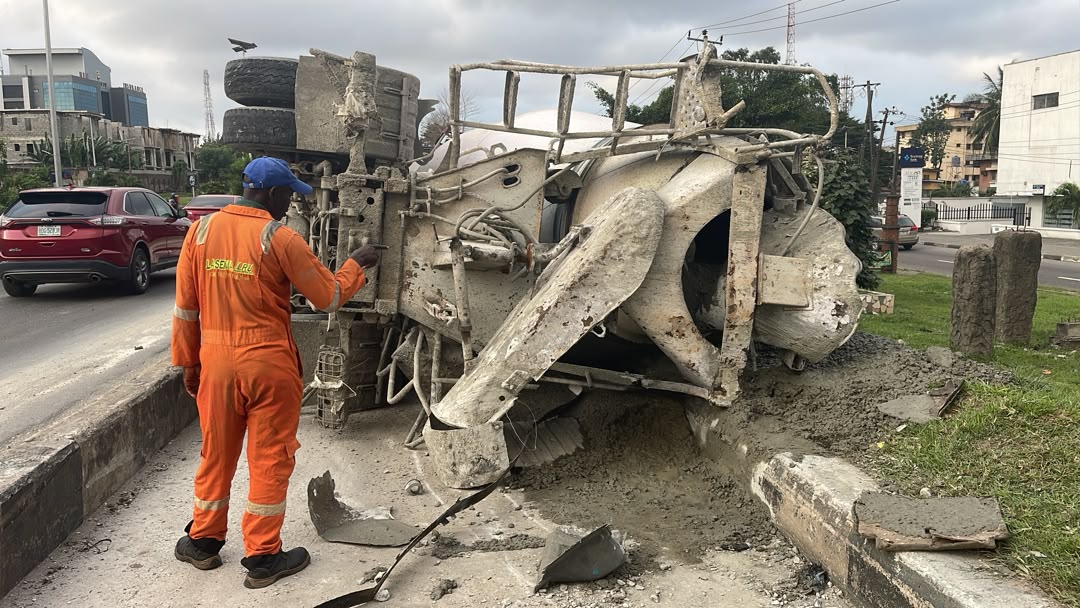
The Lagos State Emergency Management Agency (LASEMA) has restored free flow of traffic on Lagos roads after recovering two major truck incidents that obstructed vehicular movement along Ikorodu Road and the National-Ashade corridor.
According to a statement signed by the Permanent Secretary of LASEMA,
Dr. Olufemi Damilola Oke-Osanyintolu,
in the first incident, the agency received a distress alert at 5:53 p.m. yesterday, and deployed its Cobra Team stationed at Onipanu to the scene of the incident at Palm Groove inward Obanikoro along Ikorodu Road.
“Upon arrival at the scene, the Response Team observed a loaded mixer truck belonging to Ecocrete Construction Company which had been involved in a lone accident and had fallen sideways on the BRT corridor.
” Preliminary investigation suggests that the accident was due to reckless driving and overspeeding,” the PS said.
However, while no casualty was recorded, the driver of the affected truck absconded immediately after the incident.
It was further gathered that the LASEMA, in collaboration with the Lagos State Traffic Management Authority (LASTMA), and the Nigeria Police Force, promptly secured the scene, controlled traffic and commenced recovery operations to evacuate the impediment off the BRT lane.
The PS said that on the same day, at about 11:21 p.m., the LASEMA Eagle Response Team stationed at Cappa was activated following a report of a truck incident at National, Ashade.
It was learnt that a MACK truck with an unknown registration number, laden with double 20ft containers, had broken down while attempting to make a U-turn.
“Preliminary investigation revealed that the incident was caused by a tyre burst, which made the truck tilt, posing a serious threat to road users and blocking about eighty per cent of the roadway,” the PS stated
According to Oke-Osanyintolu, in line with global best practices in emergency management, the Eagle Team immediately implemented traffic diversion measures and secured the perimeter to prevent a secondary incident, while responders from LASEMA and LASTMA remained on ground managing traffic while awaiting heavy-duty equipment.
The containers were successfully recovered and placed on the Agency’s lowbed, while the MACK truck was towed to the LASTMA yard at Oshodi with the aid of a private tow truck.
The road has since been fully cleared and reopened for free vehicular movement.
While commending the gallantry and professionalism of the Cobra and Eagle Response Teams and all collaborating agencies for their swift intervention, which prevented gridlock and averted potential secondary accidents, Oke-Osanyintolu reaffirmed the commitment of the Lagos State Government to building a resilient emergency management system that guarantees prompt response to all emergencies across the State.
The Permanent Secretary also urged drivers of articulated vehicles and heavy-duty trucks to ensure proper maintenance of their vehicles, adhere strictly to speed limits and traffic regulations, and exercise utmost caution on Lagos roads.
Members of the public were also enjoined to continue to report emergencies promptly via the 767 and 112 toll-free emergency lines for immediate response.
Obalolu Darasimi
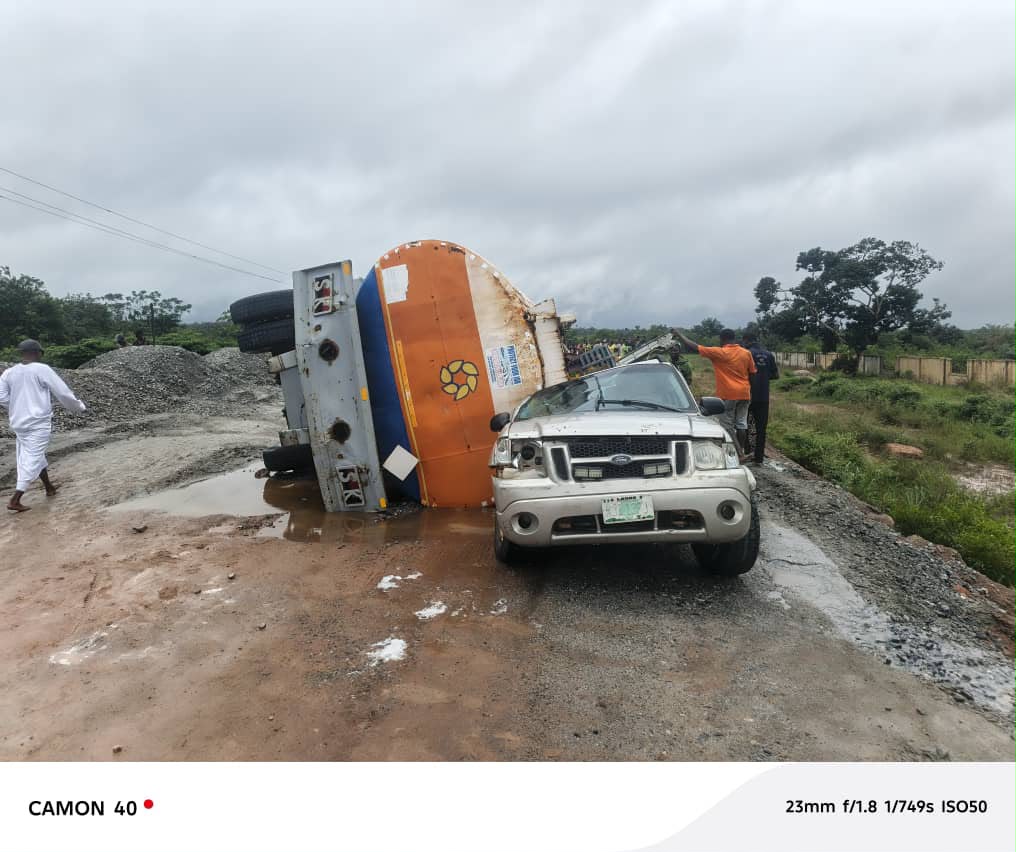
The Lagos State Emergency Management Agency (LASEMA) averted what could have been a major disaster as it recovered a fully loaded tanker with Premium Motor Spirit (PMS) at Isimi Lagos inward Itokin, Epe, Lagos.
Explaining the incident, the LASEMA Permanent Secretary, Dr Olufemi Damilola Oke-Osanyintolu, disclosed that the agency received a distress call at 10:19 a.m.; the agency’s LRT Beta Whales Team stationed at Epe was immediately activated and dispatched to the incident scene.
According to the PS, the tanker, with registration number T-18212LA, crashed into a stationary Ford pickup van loaded with animal feed, with registration number KJA-13FJ.
“Preliminary investigation revealed that the tanker, while attempting to manoeuvre past the stationary Ford pickup van which had developed a mechanical fault along the carriageway, had one of its rear tyres slip into a pit, causing it to overturn and fall onto the pickup van, leading to spillage of its highly inflammable contents onto the roadway,” the PS explained.
In collaboration with the Lagos State Fire and Rescue Service, the Lagos State Traffic Management Authority, LASTMA, the Lagos Neighbourhood Safety Corps, LNSC, the Federal Road Safety Corps, FRSC, and the Nigeria Police Force, promptly secured the incident perimeter, implemented traffic control and diversion measures, and deployed safety protocols to prevent a secondary incident.
“As a proactive measure to mitigate the risk of fire outbreak, the fallen tanker and its immediate surroundings were blanketed with chemical foam by the Lagos State Fire and Rescue Service, while the affected section of the road was temporarily closed to vehicular movement to ensure public safety.
“Through seamless coordination and professional execution, the transloading of the remaining PMS from the accidented tanker to an empty tanker was completed without incident. Subsequently, with the aid of a private tow truck, both the accidented tanker and the affected Ford pickup van were recovered off the roadway and taken to Ketu Police Station. The road has since been reopened and is now free for vehicular activities,” Oke-Osanyintolu said.
Neither loss of life nor injury was recorded in the incident.
Oke-Osanyintolu commended the swift response and synergy of all emergency responders whose professionalism averted what could have resulted in a major disaster.
He also reiterated the commitment of the Lagos State Government under the leadership of Mr Babajide Olusola Sanwo-Olu to the continuous strengthening of emergency preparedness, rapid response capacity, and protection of lives and property across the State.
The Permanent Secretary appealed to motorists, particularly drivers of heavy-duty vehicles and tankers conveying combustible products, to ensure their vehicles are in good mechanical condition, adhere strictly to traffic regulations, and exercise utmost caution on Lagos roads. Members of the public are encouraged to report any emergency or road incident promptly via the 767 and 112 toll-free emergency lines for immediate intervention.
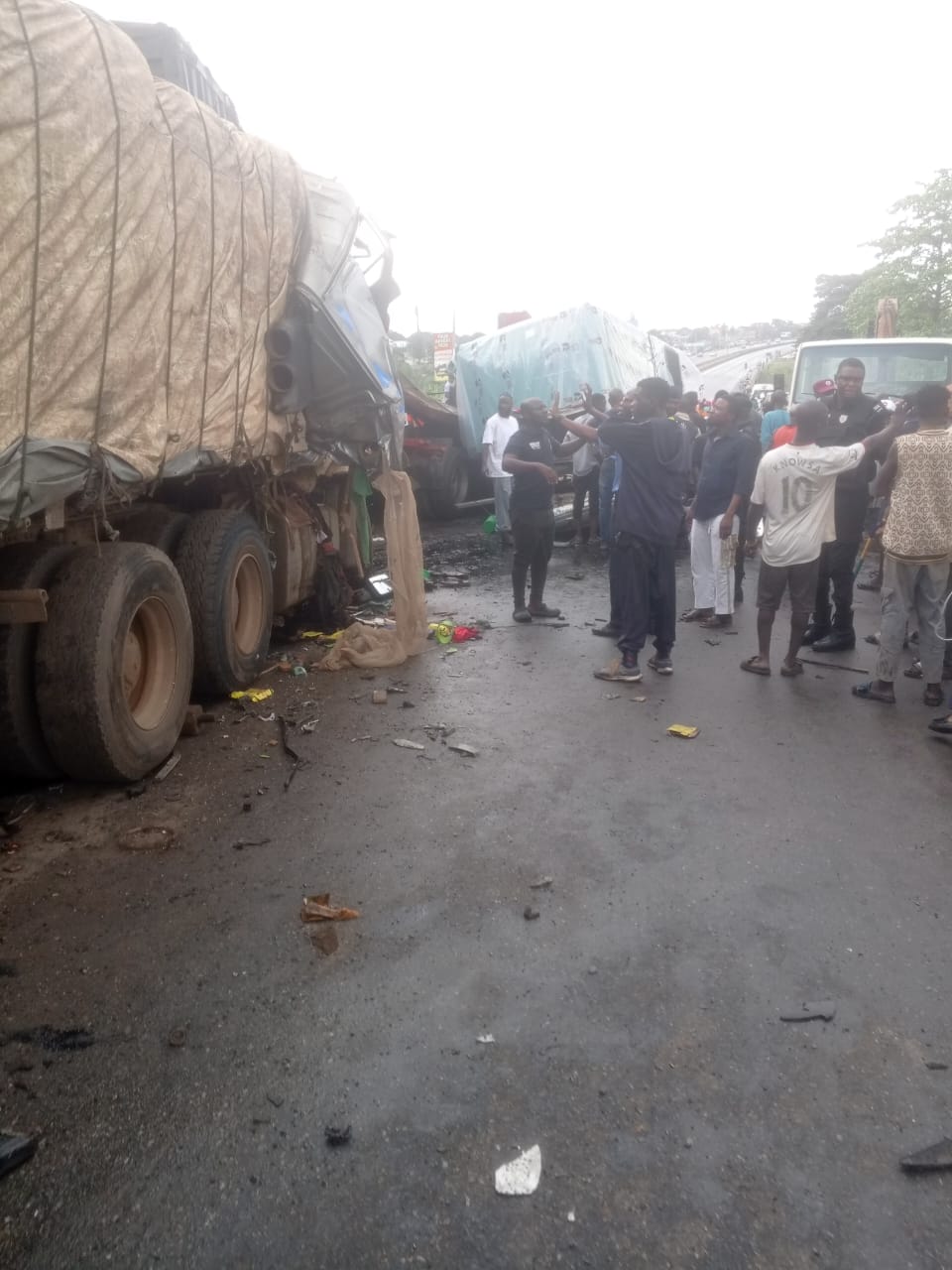
Five vehicles on Monday afternoon crashed on Otedola Bridge, inward Berger
According to a statement by the Permanent Secretary of the Lagos State Emergency Management Agency (LASEMA), Dr Olufemi Damilola Oke-Osanyintolu, the agency promptly responded to the situation by deploying its rescue team to the scene of the accident.
“The LRT Tiger Squad stationed at C3 was dispatched at 1:18 p.m. upon receiving a distress call regarding the incident and arrived at the scene at 1:28 p.m. On arrival, first responders observed a multiple-vehicle crash involving five vehicles, including a truck laden with a generator, a containerised truck with registration number ENU 135ZG, a loaded trailer with an unknown registration number, a white Honda with registration number LSR 870BF, and a Lexus car with registration number KTU 682HX,” Oke-Osanyintolu said.
He explained that the accident was as a result of a containerised truck which developed a mechanical fault while in motion, “resulting in loss of control before ramming into three other vehicles, while another truck subsequently rammed into them from behind, leading to the multiple collision.”
It was gathered that the Agency’s LRT, alongside the Lagos State Traffic Management Authority, LASTMA, and the Nigeria Police Force, promptly implemented traffic control and safety measures to prevent secondary incidents and ensure the safety of road users.
“Through a swift and coordinated rescue operation, all trapped victims were rescued alive. The victims received immediate medical attention at the scene from the Lagos Response Unit Paramedics before being transferred to the Trauma Centre for further treatment. Fortunately, no loss of life was recorded, Oke-Osanyintolu further stated.
Recovery operations are currently ongoing with the support of private towing trucks and a private crane to evacuate the affected vehicles from the roadway and restore free flow of traffic.
LASEMA PS commended the prompt intervention and professionalism of the Agency’s response team, LASTMA, the Nigeria Police, and private partners whose synergy ensured the preservation of lives.
He reiterated the commitment of the Lagos State Government to the protection of lives and property through continuous investment in emergency response capacity, modern equipment, and strategic decentralisation of response units for rapid intervention across the state.
The Permanent Secretary, therefore, urged motorists, particularly drivers of heavy-duty and articulated vehicles, to ensure regular maintenance of their vehicles, adhere strictly to road safety regulations, and exercise utmost caution while driving on major highways.
He also enjoined the members of the public to report all emergencies promptly through the 767 and 112 toll-free emergency lines for swift intervention.


LASEMA clears crash scene, restores traffic flow

LASEMA averts disaster as tanker loaded with 45,000 litres of PMS crashes

Five vehicle crash on Otedola Bridge
-

 Fashion9 years ago
These ’90s fashion trends are making a comeback in 2017
-
Entertainment9 years ago
The final 6 ‘Game of Thrones’ episodes might feel like a full season
-
Business9 years ago
3 Ways to make your business presentation more relatable
-
Business9 years ago
The 9 worst mistakes you can ever make at work
-
Fashion9 years ago
According to Dior Couture, this taboo fashion accessory is back
-
Sports9 years ago
Steph Curry finally got the contract he deserves from the Warriors
-
Fashion9 years ago
Model Jocelyn Chew’s Instagram is the best vacation you’ve ever had
-
Sports9 years ago
Phillies’ Aaron Altherr makes mind-boggling barehanded play